
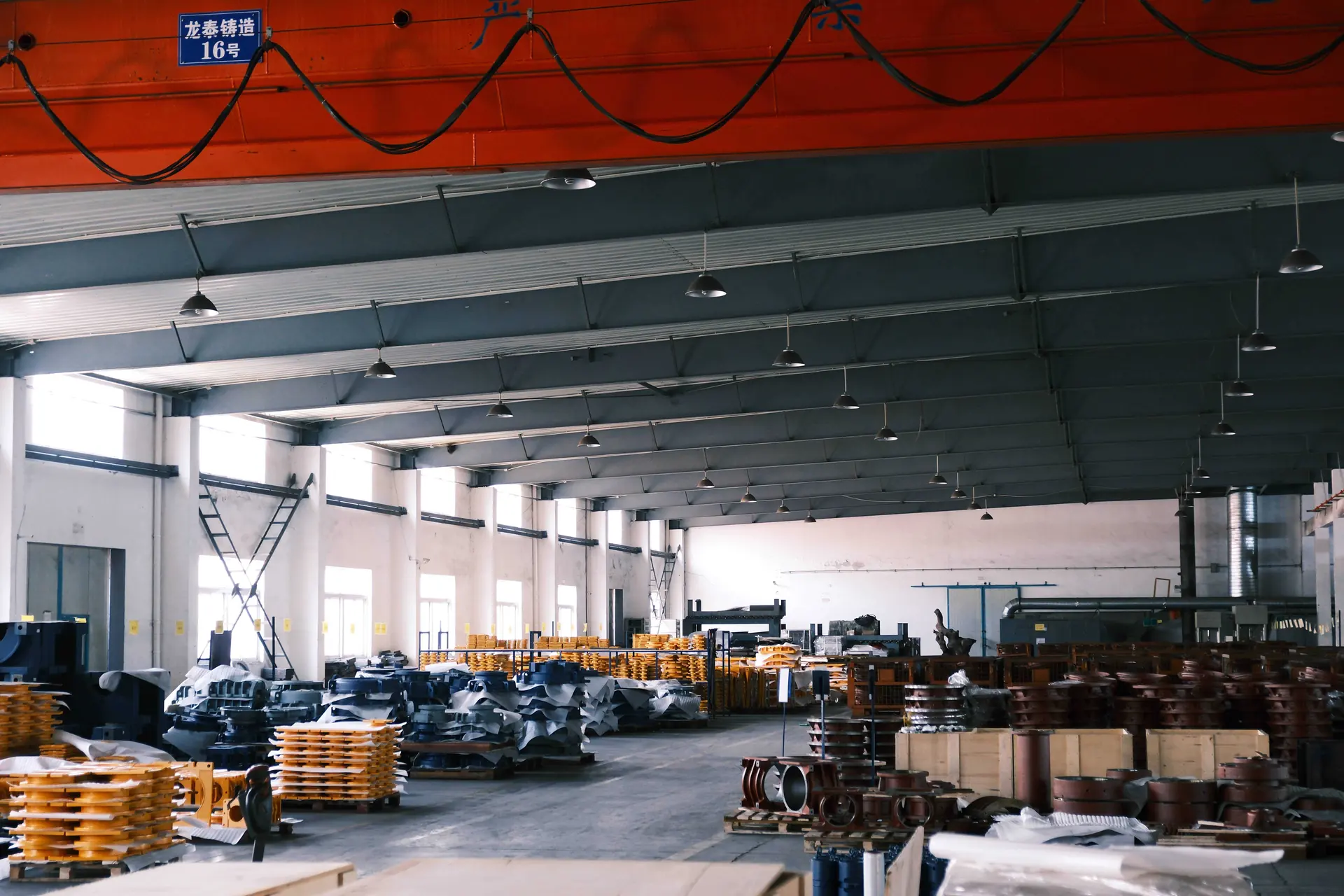
The Difference Is the Graphite
In gray iron, graphite forms as flakes. The flake edges act as internal notches, so gray iron has moderate tensile strength and almost no elongation. In return it machines easily, damps vibration well and conducts heat.
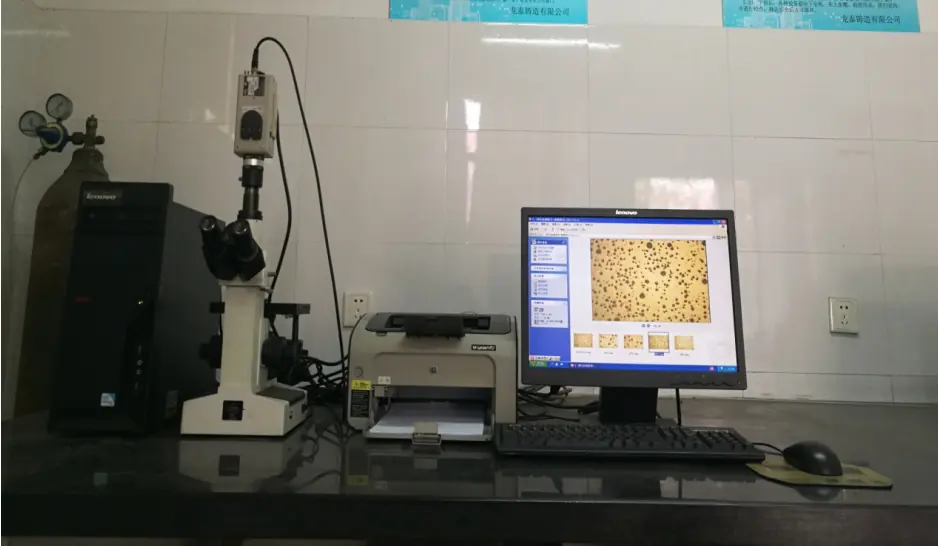
Ductile iron, also called nodular or SG iron, receives a nodularizing treatment before pouring so that the graphite forms spheres. Spheres interrupt the metal far less than flakes, which gives ductile iron higher strength and measurable elongation. Our lab examines the microstructure under a metallographic microscope and reports it with micrographs.
Grades We Pour
| Iron and standard | Grade | Minimum tensile strength | Minimum yield · elongation | Typical parts |
|---|---|---|---|---|
| Gray iron, ASTM A48 | Class 30 · 40 · 50 | 30 · 40 · 50 ksi (207 · 276 · 345 MPa) | Not specified | Bearing housings, pedestals, discharge bodies, head plates |
| Gray iron for pressure parts, ASTM A278 | Class 40 | 40 ksi (276 MPa) | Not specified | Cylinders, cylinder covers, bearing retainers |
| Gray iron, GB/T 9439 | HT200 · HT300 | 200 · 300 MPa | 130–195 · 195–260 MPa · 0.3–0.8% | Motor end covers, junction boxes; machine tool bases and columns |
| Ductile iron, ASTM A536 | 60-40-18 | 60 ksi (414 MPa) | 40 ksi (276 MPa) · 18% | Pump casings, suction plates, stuffing boxes, valve housings |
| Ductile iron, ASTM A536 | 65-45-12 | 65 ksi (448 MPa) | 45 ksi (310 MPa) · 12% | |
| Ductile iron, ASTM A536 | 80-60-03 | 80 ksi (555 MPa) | 60 ksi (415 MPa) · 3% |
When Gray Iron Is the Better Choice
- Vibration damping: machine tool bases, columns and tables, which we cast in gray iron ASTM A48 Class 45.
- Complex housings and covers: gray iron fills thin, intricate sections well and machines quickly, which keeps cost down on parts such as motor end bells and junction boxes.
- Pressure-containing compressor parts: cylinders, cylinder covers and bearing retainers to ASTM A278.
- Parts loaded mainly in compression rather than in tension or by impact.
When Ductile Iron Is the Better Choice
- Heavy load, shock or impact: slurry pump casings and suction plates face heavy slurry loads and erosion, where ductile iron’s strength and elongation matter.
- Thinner sections for the same load: higher strength allows lighter walls than gray iron.
- Parts that must not fail by sudden fracture: elongation gives a margin before cracking.
Within ductile iron, 60-40-18 favors elongation and toughness, 65-45-12 balances strength and elongation, and 80-60-03 gives higher strength and hardness with lower elongation. Most slurry pump castings in our catalog are 65-45-12. Ductile iron requires nodularizing treatment and tighter process control, so it usually costs more per kilogram than gray iron.

Grade Equivalents
Drawings often cite Chinese, European or Japanese grades. The table gives approximate equivalents for reference; the standard on your drawing governs.
| China · GB/T | Europe · EN | USA · ASTM | Japan · JIS |
|---|---|---|---|
| HT200 | EN-GJL-200 | A48 Class 30 | FC200 |
| HT250 | EN-GJL-250 | A48 Class 35 / 40 | FC250 |
| HT300 | EN-GJL-300 | A48 Class 45 | FC300 |
| HT350 | EN-GJL-350 | A48 Class 50 | FC350 |
| QT400-18 | EN-GJS-400-18 | A536 60-40-18 | FCD400-18 |
| QT450-10 | EN-GJS-450-10 | A536 65-45-12 | FCD450-10 |
| QT600-3 | EN-GJS-600-3 | A536 80-60-03 | FCD600-3 |
How We Verify the Grade
Every heat is analyzed on a SPECTRO optical emission spectrometer (29+ elements) before pouring. Test bars are pulled on a 30 t tensile testing machine for tensile strength and elongation, hardness is checked in HB or HRC, and metallography confirms the graphite form. Common cast iron, cast steel and stainless steel grades have been tested for physical properties by a third party. See Melting for how chemistry is controlled.
Not sure which iron suits your part? Send your drawing for engineering review. We reply within 72 hours.